A 60-Second Desk Pause: A Simple Sensory Ritual for Screen-Heavy Days
Published
Shop the ritual in this guide ↓
A screen crowded with open tabs. An email you have read three times without absorbing a word. Shoulders that have quietly crept toward your ears while your attention was locked inside a document.
When a working day becomes entirely mental, trying to "think your way out of overthinking" rarely works. At J.N HERBACEOUS, we use a simpler threshold: give attention somewhere physical to land for sixty seconds, then return to a single chosen action.
The 60-Second Sensory Pause at a Glance
| Stage | Time Window | Physical Action | Sensory Focus |
|---|---|---|---|
| Stage 1: Support | 0–20 seconds | Look away from the screen; rest your hands on your desk or lap and place both feet flat on the floor. | Notice the solid weight of the chair beneath you and let your jaw and shoulders settle naturally. |
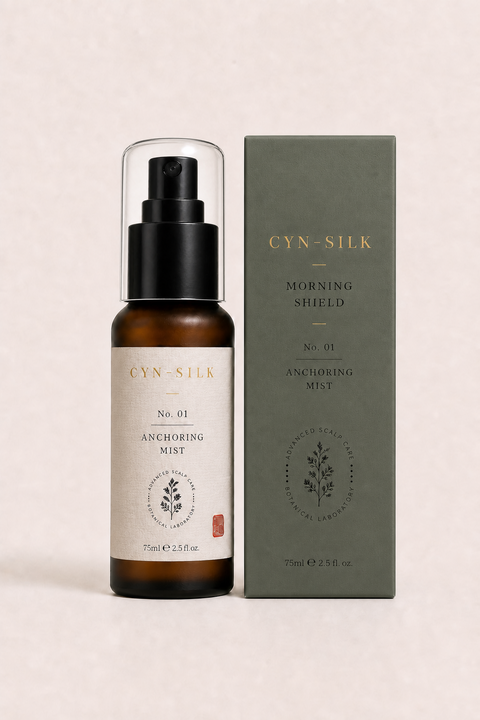
| Stage 2: Contact | 20–40 seconds | Rest clean finger pads lightly at your hairline or crown—or use this moment in your morning home-office start for CYN-SILK No.01 Anchoring Mist. | Attend to physical touch, hair texture, or the cool, weightless feel of a morning botanical mist at the partings. |
| Stage 3: Return | 40–60 seconds | Allow one unhurried, comfortable exhalation, then bring your eyes back to the workspace. | Choose one concrete next step—write one sentence, review one paragraph, or close one finished tab. |
Step-by-Step: Practicing the Minute
Use the three 20-second intervals as an unhurried rhythm rather than a stopwatch test. Keep your breathing natural throughout.
0–20 Seconds: Find the Support Already There
Pause your typing and shift your gaze away from the monitor toward a neutral point across the room. Let your hands rest quietly on the desk surface or in your lap. Feel where your feet meet the floor and how the seat carries your weight. Without forcing a rigid posture, notice whether your shoulders or jaw are clenched, and allow them to soften.
20–40 Seconds: Give Attention Something Tangible
Bring your focus to a single physical point of contact:
- At the Morning Threshold (With No.01): If you are beginning your morning routine beside the mirror or at a home desk, part your hair and spray CYN-SILK No.01 Anchoring Mist evenly onto the scalp, keeping the mist away from the eye area. Notice the fine, non-greasy dispersion settling at the roots.
- During Midday Work Breaks (Product-Free Tactile Anchor): In a shared office or during additional pauses throughout the afternoon, simply rest clean finger pads lightly against an accessible area of your scalp—or notice the cool grain of the desk beneath your palms—without scratching or pulling at the hair.
40–60 Seconds: Follow an Easy Breath, Then Choose One Action
Let a comfortable exhalation unfold at your own pace; there is no need to hold your breath or count a strict ratio. When the breath finishes, look back at your workspace and select one specific action to begin: reply to one message, read one page, or write down the next task. The pause succeeds by giving your attention a clear place to restart.
When Thought Becomes a Closed Room: Si Ze Qi Jie and Tu Na
Why does a brief tactile pause feel so different from scrolling through another feed on your phone?
Our editorial perspective draws on two classical Chinese concepts:
- Si Ze Qi Jie (思则气结 — Overthinking Knots the Flow): In the classical medical text Huangdi Neijing (Suwen, Chapter 39), excessive rumination is described through the image of knotted movement—thought circling inside a closed room without an exit (explored further in Cultivating the Middle: Spleen-Earth Philosophy). Returning attention to physical contact—feet on the floor, fingertips at the crown—shifts awareness out of abstract loops and back into the room you actually inhabit.
- Tu Na (吐纳 — Mindful Breath Cultivation): Traditional breath practices invite us to notice the natural movement of air rather than turning relaxation into another high-pressure task.
From Morning Awakening to Evening Release
A sustainable workday relies on clear bookends:
- Morning Start: Begin daily scalp care with CYN-SILK No.01 Anchoring Mist (75 ml · $42)—a quick, water-based spray that leaves hair light and movable.
- Evening Wind-Down: On wash nights, once the workday is closed and your scalp is clean and dry, complete your routine with CYN-SILK No.02 Flourishing Elixir (15 ml · $58)—a grapeseed-oil-based leave-in elixir massaged gently into the roots and left in overnight.
- Complete Day-and-Night Pairing: Explore the CYN-SILK No.01 + No.02 Scalp Ritual Duo ($100), or compare both formats in our Scalp Mist vs. Elixir Guide and Scalp Mist vs. Scalp Oil.
Frequently Asked Questions
Will CYN-SILK No.01 Anchoring Mist flatten styled hair or leave an oily residue?
No. No.01 is a water-based botanical scalp mist (75 ml) containing Platycladus orientalis leaf extract. Customers consistently note that the fine spray feels light at the roots and dries down quickly without a sticky or greasy finish.
How does No.01 fit with a midday desk pause?
No.01's documented direction is daily morning scalp care: spray evenly onto the scalp while avoiding the eye area. If you take additional 60-second pauses during a busy afternoon, use the product-free fingertip or desk-contact version of this sequence—you do not need to reapply product at every work break.
Can I practice this 60-second pause in a shared or fragrance-free office?
Yes. Keep your eyes open, rest your feet flat on the floor, and use gentle finger-pad contact at the crown or rest your hands on your desk. The sensory pause works quietly anywhere without requiring a product step or special seating.
What if my scalp still feels tight at the end of the workday?
When work finishes for the evening, transition from a 60-second pause to a full closing sequence. See The 4-Step Eastern Nighttime Wind-Down Ritual and Before the Pillow: Gentle Neck and Scalp Care.
Bring the ritual home
A water-light mist for your morning. A quieter rhythm for the rest of the day.
U.S. standard shipping $15 · complimentary at $120. Dispatch in 3–5 business days. Transit: 5–8 business days.